
Meghan Markle’s claim against Associated Newspapers regarding the publication of a letter she wrote to her father has had its preliminary hearing on 24 April 2020, as reported by the BBC. Continue reading
Privacy
Citation: INFORRM: Markle v Associated Newspapers, an interesting preemptive analysis
INFORRM has an excellent two part post on Meghan Markle’s action for misuse of private information against the Associated Newspapers. Continue reading
The conceptualisation of privacy – a useful image
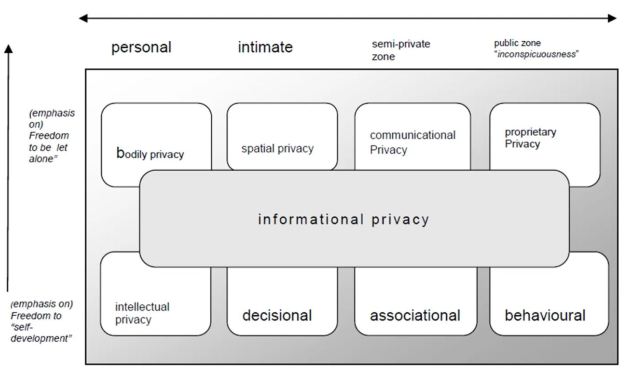
This was taken from the case of Puttaswamy v Union of India. The case entrenched the right to privacy under Indian law. The infographic provides a useful means for distilling the concept of privacy and it’s scope.
Data protection rights
Personal data, such as your name, likeness or any other information which can be used to identify you is highly sensitive.
Protecting and bringing actions on the basis of your personal data being harvested, used or misused is a key foundational right to privacy.
Further, the control over autonomy of such data is paramount in data-driven economies.
Actions maybe fall into a variety of categories depending upon context. An non-exhaustive list of English law-oriented rights can be found below:
– Computer Misuse Act 1990, acts which involved the misuse of computers in perpetrating offences
– Data Protection 1998, data protection, misuse and management rights
– Freedom of Information Act 2000, requesting data about you or others, typically referred to as FOI’s
– Malicious Communications, sending false or threatening communications
– Regulation of Investigatory Powers Act 2000, data surveillance and harvesting rights
– Fraud Act 2000, offences which involve people masquerading as others including the misuse of their personal data
– Data Protection Act 2018 and General Data Protection Regulation, rights to amend, obtain, delete and manage data. Also contain data breach reporting guidelines.
In seeking to protect your privacy you may look to engage a number of actions simultaneously or concurrently. For example, phone hacking will merit a number of offences for the interception of communications and misuse of personal data.
Many actions which you see featured here will typically involve a data protection oriented offence due to the broad definition and strict protections on the use of personal data. The definition refers to any information which can be used to identify you.
As such data privacy is a key aspect of privacy rights and an ever evolving issue. Some examples include phone hacking, sim jacking, fraud, hate campaigns and data breaches all which engage data protection rights in multi-faceted ways.
Citation: INFORRM: Meghan Markle, Ben Stokes, Gareth Thomas: three reasons why UK press needs help to understand ‘public interest’ – Alexandros Antoniou
The end of the kiss and tell story? – PJS v News Group Newspapers Ltd [2016] UKSC 26
The case of PJS concerned an application for an interlocutory injunction. PJS was well known in the entertainment business and married to YMA, who was similarly well known. They had young children. In 2007 or 2008 PJS met AB and had occasional sexual encounters with them despite AB having a partner, CD. In December 2011 PJS had a three-way sexual encounter with AB and CD following which the sexual relationship with PJS and AB came to an end.
Ben Stokes and Gareth Thomas in the press – Protecting privacy in the spotlight
Many will have heard of the Sun’s recent egregious intrusion into the private and family life of cricketer Ben Stokes. The offending article by the Sun delves into the family life of the famous cricketer in a manner which could be seen to breach the privacy rights of Stokes and his family.
The incident has placed the conduct of English journalists, particularly the Sun, under the spotlight. INFORRM has an excellent post on the issue.
Stokes statement on the article, released on Twitter, can be found here.
Many will also be aware of the exposing of rugby player Gareth Thomas’ HIV status following black mail attempts. This move is highly invasive and could be considered a misuse of private information.
The Independent Press Standards Organisation has commented on the incidents. This notes how the Editor’s Code operates to protect individuals in such scenarios and condemns the sensationalist headlines of articles intruding upon privacy rights.
 The Privacy Perspective